Australian Open heat rules: What is the Extreme Heat Policy and Heat Stress Scale? When is play suspended? How hot can it get?
Published 23/01/2026 at 10:00 GMT
What is the Extreme Heat Policy and Heat Stress Scale at the Australian Open, when would play be suspended due to the heat, how do players cope with the heat, how hot does it get in Melbourne? The first Grand Slam of the season is often played in high temperatures in the Australian summer. We explain everything you need to know about the rules with the temperature set to soar at the tournament.
Medvedev explains why he was downing pickle juice at key moment in win
Video credit: TNT Sports
The Australian Open often serves up some of the toughest conditions of the tennis season for players.
With the Grand Slam played in the summer Down Under, temperatures can soar close to 40 degrees Celsius.
If the temperatures climb too much, then it can lead to play being suspended at the tournament.
So what is the Australian Open Extreme Heat Policy and Heat Stress Scale, and how hot can it really get in Melbourne?
How hot does it get at the Australian Open?
At this time of year, it can get seriously hot in Melbourne.
In 2014, nine players retired from their opening matches due to severe heat as temperatures hit a staggering 43.9 degrees Celsius (111 Fahrenheit).
The Grand Slam acted to prevent a repeat of that by introducing the Heat Stress Scale in 2019.
The guidelines, which come under the Extreme Heat Policy, determine whether conditions are safe enough for play and if matches could be suspended.
The Extreme Heat Policy was enforced at the 2023 Australian Open as temperatures hit 36 degrees Celsius and the stress scale reached level five, meaning matches on the outside courts were suspended.
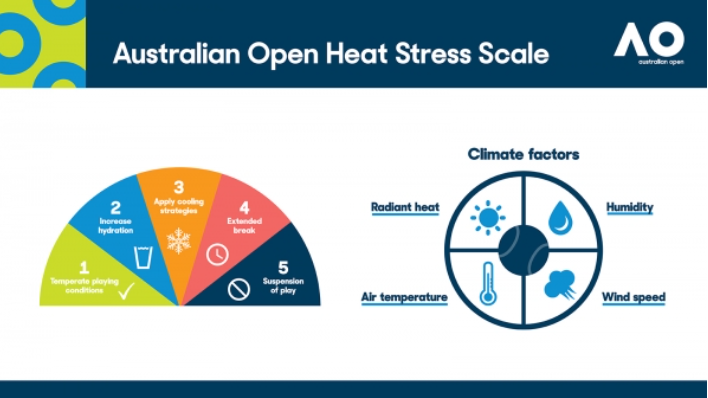
Australian Open Heat Stress Scale
Image credit: TNT Sports
The matches were halted on all outside courts for almost three hours, while play continued on the main show courts.
The normal temperature for the middle of January in Melbourne is 26c (around 78 degrees Fahrenheit), according to Accuweather. But temperatures can regularly float between 30 and 40 degrees Celsius over the course of the tournament.
On Saturday, January 24, the temperature is expected to get close to 40c.
The schedule has been adjusted due to the weather, with play starting an hour earlier on the main show courts (23:30 UK time) and an extra match played on Margaret Court Arena, which has a roof.
This year's Australian Open has also seen a ball girl faint in the heat and be helped by Zeynep Sonmez.
'A mental challenge and physical battle'
The hot weather on hard courts (which give off more heat than grass or clay) can lead to gruelling conditions for players, who can try to cool down by finding shaded spots on the court or by draping ice towels around their shoulders during changeovers.
But when it comes to playing over three, four or five hours in the sun, it can be a battle of endurance.
Women's world No. 1 Aryna Sabalenka said she was pleased not to be playing in the heat on Saturday after winning her third-round match a day earlier.
"I wouldn't like to play the match because I think it's too much on our bodies. But I'm glad that at least we have a heat rule. There is a lot of ice. It's all on players to take that heat rule. At least in the stadiums it's going to be covered.
"But the weather being crazy. It's a lot of adjustment on the strings, your approach to the match. It depends on the weather because it's going like a roller coaster. So yeah, we'll see who adjusts better in the next few days."
/origin-imgresizer.tntsports.io/2026/01/18/image-3a27a516-0a86-49cf-a0cd-97bc1336ba9a-85-2560-1440.jpeg)
Watch 'incredible' moment Sonmez halts play to help fainting ball kid
Video credit: TNT Sports
Three-time Australian Open runner-up Daniil Medvedev will also be watching on rather than playing when the heat hits on Saturday.
He explained the challenges of playing in the high temperatures following his five-set comeback win.
"The problem is that unless you put like 10 towels on your bags, they get so hot because the thing is off for people to see the match. I think maybe there are tiny bit of things to do there.
"What happens is when you sit, whatever you touch around is brutally hot. You have like just 40 seconds on the chair. You don't have 20 seconds to look around. Maybe a little bit there.
"But look, we sometimes play in these conditions. Some guys retire. Some guys cramp. It's going to happen again not only in Australia. Let's see what happens tomorrow."
What is the Australian Open Extreme Heat Policy?
Starting with the 2019 Australian Open, the tournament organisers introduced the 'AO Heat Stress Scale' to provide clear guidelines to be followed when temperatures rise considerably.
The official Australian Open website outlines the scale and explains how it is implemented when required during the course of the tournament.
"The Heat Stress Scale will be used to measure four climate factors - radiant heat (strength of the sun), air temperature in the shade, relative humidity and wind speed. These will be measured at five positions around the precinct, including on court in Rod Laver Arena, Margaret Court Arena and Melbourne Arena. The scale starts at (1) for temperate playing conditions and escalates to (5) - suspension of play," a statement on the organisation's website explained.
"Under the EHP, the Tournament Referee will allow a 10-minute break between the second and third sets in both women’s and junior singles matches and a 15-minute break in wheelchair singles matches when a four (4.0) is recorded on the AO HSS prior to or during the first two sets of the match.
/origin-imgresizer.tntsports.io/2026/01/23/image-6f4f5133-0e2e-441d-91fe-e2f29bc45e0c-85-2560-1440.jpeg)
Watch as fans boo Putintseva after match point as she dances and riles them
Video credit: TNT Sports
"In the men’s singles, a 10-minute break will be allowed after the third set when a four (4.0) is recorded on the AO HSS prior to or during the first three sets of the match.
"If a five (5.0) is recorded on the AO HSS, the Tournament Referee can suspend the start of matches on outside courts and all matches in progress continuing until the end of an even number of games in that set or completion of the tie break before play will be suspended.
"Matches on Rod Laver Arena, Margaret Court Arena and Melbourne Arena will stop after an even number of games in that set or completion of the tie-break when the Tournament Referee can decide to close the roof for the remainder of the match and the following matches when the EHP is still in effect."
When does the roof get closed due to heat?
There are air conditioning systems on Rod Laver Arena, Margaret Court Arena and John Cain Arena.
These courts also have roofs that can be closed to help keep the conditions cooler.
With regard to the use of the roof, the Australian Open say: "The decision to close an arena roof rests solely with the tournament referee.
"Roofs on Rod Laver Arena, Margaret Court Arena and Melbourne Arena can be closed in the event of rain or the Extreme Heat Policy being invoked prior to the scheduled start of play. If play commences with a roof closed, it will remain closed for the entire match."
- - -
Stream every match of the 2026 Australian Open live and on-demand on discovery+
Related Topics
Advertisement
Advertisement